
Understand Premature Ventricular Contractions (PVC) on Apple Watch ECG
Premature ventricular contractions (PVCs) are early heartbeats originating in the lower chambers of the heart. Learn what PVCs look like on Apple Watch ECG and how ECG+ helps you identify and track them.
4 min read

In a healthy heart, every beat begins with an electrical signal from the sinoatrial (SA) node in the upper right chamber. That signal travels through the atria, reaches the atrioventricular (AV) node, and then travels down into the ventricles, causing them to contract and pump blood out to the body and lungs. The whole process happens in a coordinated, predictable sequence.
How PVCs Appear on an Apple Watch ECG
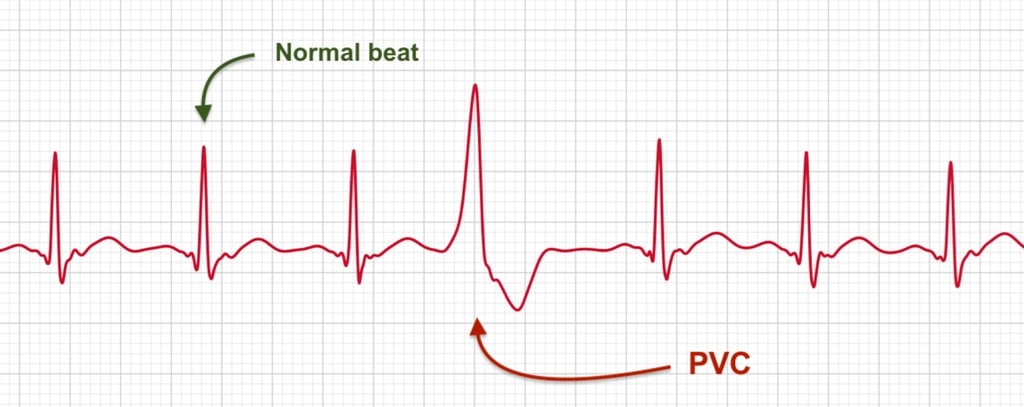
On a normal ECG, each heartbeat produces a narrow, well-formed QRS complex, preceded by a P wave and followed by a T wave. PVCs have a distinctly different appearance that makes them identifiable even on a single-lead Apple Watch ECG recording. When a PVC occurs, you will typically see:
No P wave before the beat: because the signal does not originate from the SA node, there is no normal atrial activation beforehand
A wide, abnormal QRS complex: broader and more unusual in shape than surrounding normal beats, often with a large deflection in the opposite direction to normal
A compensatory pause: a longer than usual gap after the PVC before the next normal beat, as the heart resets its rhythm
A return to normal: the beat following the pause is typically a normal sinus beat
On an Apple Watch ECG recording, ECG+ app marks these abnormal beats directly on the waveform, making it easier to identify individual PVCs within a recording.
PVC Patterns: Bigeminy, Trigeminy and Couplets
PVCs do not always occur in isolation. They can appear in repeating patterns that have specific clinical names:
Bigeminy: every second beat is a PVC, alternating with a normal beat in a regular pattern
Trigeminy: every third beat is a PVC, occurring after every two normal beats
Quadrigeminy: every fourth beat is a PVC
Couplets: two PVCs occurring back to back, with no normal beat in between
Triplets: three PVCs in a row, which is considered a brief run of ventricular tachycardia
These patterns are more clinically significant than isolated, infrequent PVCs and are more likely to warrant further investigation by a doctor.
Are PVCs Dangerous?
For the majority of people, occasional PVCs are entirely benign. They are extremely common, occurring in most adults at some point, and are frequently triggered by everyday factors such as:
Caffeine and stimulants
Stress or anxiety
Lack of sleep
Alcohol
Strenuous exercise in some individuals
Dehydration
In people with an otherwise healthy heart, infrequent PVCs rarely require treatment beyond addressing the trigger.
However, PVCs become more concerning in certain situations. You should speak to a doctor if:
PVCs are very frequent, generally considered above 10,000 per day or more than 10 to 15% of total heartbeats (known as PVC burden)
You experience PVCs in patterns such as couplets or triplets
PVCs are accompanied by symptoms such as dizziness, chest pain, shortness of breath, or fainting
You have an existing heart condition such as heart failure, cardiomyopathy, or a previous heart attack
PVCs are new and unexplained, with no obvious lifestyle trigger
In people with structural heart disease, frequent PVCs can worsen heart function over time and may require treatment.
What Symptoms Do PVCs Cause?
Many people with PVCs feel nothing at all and only discover them through an ECG recording. When symptoms are felt, the most common descriptions include:
A skipped beat or a brief pause in the chest
A strong or forceful beat immediately after the pause (the compensatory beat)
A fluttering or thumping sensation in the chest
Occasional lightheadedness if PVCs are frequent
These sensations can feel alarming but are usually caused by the compensatory pause and the stronger than normal beat that follows, rather than anything dangerous in itself.
How Apple Watch ECG Detects PVCs
Apple Watch ECG records a single-lead ECG during a 30-second recording. Because PVCs produce a distinctly wide and abnormal QRS complex, they are generally visible on a single-lead recording and can be reliably identified by ECG analysis tools like ECG+.
The ECG+ app goes beyond what the standard Apple Watch ECG app provides. It analyses each individual heartbeat within your recording, flags PVCs, identifies patterns such as bigeminy and trigeminy, and tracks PVC burden over time. This gives you and your doctor a much richer picture of how frequently PVCs are occurring and whether any patterns are developing.
It is worth noting that Apple Watch ECG captures only a 30-second snapshot. If PVCs are infrequent, they may not appear in every recording. If you suspect PVCs but are not capturing them, try recording during a moment when you feel symptoms.
Next Steps if You See PVCs on Your Apple Watch ECG
Note the frequency: are you seeing one or two per recording, or do they appear in most beats?
Check for patterns: are they isolated, or occurring in bigeminy, trigeminy, or couplets?
Track your triggers: note whether PVCs appear more after caffeine, poor sleep, alcohol, or stress
Record symptoms: document any dizziness, chest discomfort, or palpitations that coincide with PVC recordings
See your doctor: if PVCs are frequent, patterned, or symptomatic, share your ECG+ recordings with your doctor and request a formal evaluation
Consider a Holter monitor: for a complete picture of PVC burden over 24 to 48 hours, your doctor may recommend ambulatory ECG monitoring